
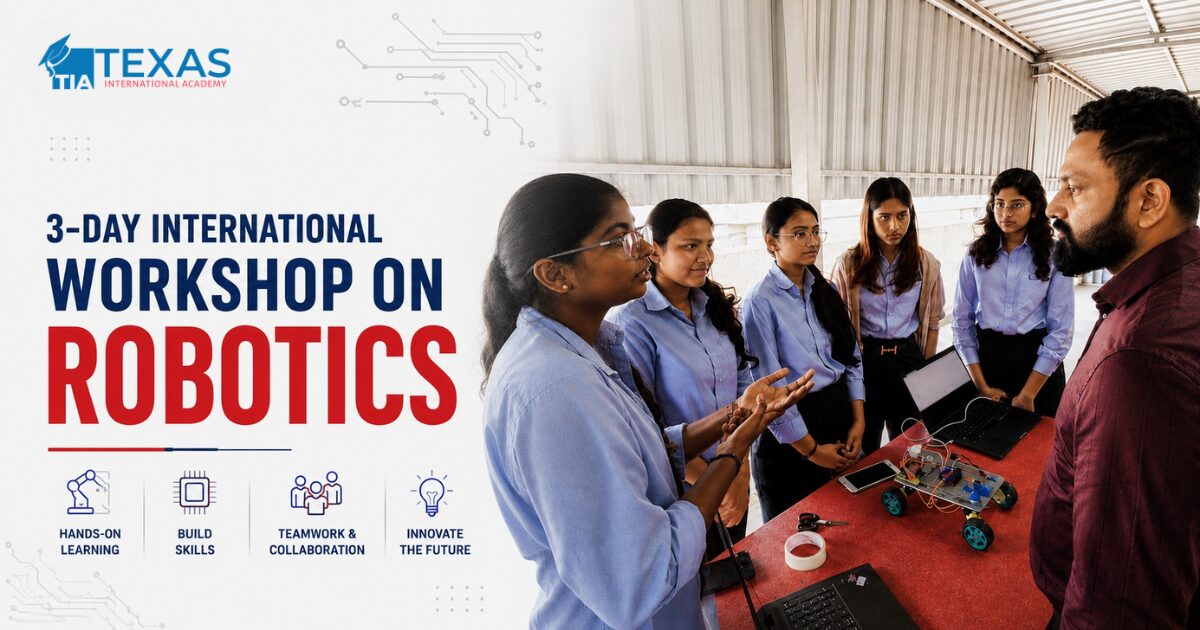
Texas International Academy conducted a 3-day International Robotics Workshop where 30 students gained hands-on experience and developed robotics prototypes.
Introduction
The TIA has organized an International Workshop on Robotics for 3 days which will take place from 17th, 18th, and 19th. It was indeed an outstanding opportunity for the students as they learned all about robotics with practical experience.
In the above-mentioned 3 days, 30 students were grouped into 10 teams wherein the activities were based on the basic knowledge of robotics, programming, sensors, motor driver, wireless communication, and prototyping. Students used some tools such as Arduino, ESP32, and Raspberry Pi Pico wherein they were taught how to integrate all these parts to create robots.
In contrast to forcing the students to pay attention only to the theories, the workshop let them get hands-on experience in experimenting, designing and testing their creations.
Robotics Workshop at Texas International Academy
Robotics Workshop is a three-day workshop where the students have an opportunity to learn about robotics and technology.
As for this workshop, the students learned about the use of microcontrollers, sensors, motors, and communication systems in robotics. Additionally, the individuals participated in robot construction and programming.
From the Robotics Workshop, the learners got a chance to learn practical robotics.
Key Areas Covered During the Workshop
These topics included those forming the basis of robotics and automation.
Introduction to Raspberry Pi Pico and Basic Robotics
The students were introduced to the Raspberry Pi Pico and concepts of basic robotics. This would enable them to appreciate the functionality of the microcontroller in control of electronic/robotic devices.
Sensors and Motor Control
Sensors play a key role in enabling robotic systems to gather data from their environment while motors play a key role in creating motion. The students learnt about the connection and control of these components as part of a robotic device.
Robotics Hardware & Software
The students took part in sessions involving robotics hardware and software. This would enable them to appreciate the workings of hardware and software to execute certain functions.
Wireless Communication
The workshop also exposed the students to wireless communication through technologies such as Bluetooth and ESP-01. This allowed them to understand the means by which robotic systems can communicate and transfer information wirelessly.
Obstacle Avoidance and Line Following Robots
In practical applications of robotics, students learnt about the construction of obstacle avoidance and line following robots.
30 Students, 10 Teams and Hands-On Project Development
One of the main aspects of the workshop was the development of projects as teams.
All 30 students who attended the workshop were placed in 10 teams that were able to collaborate and use all knowledge acquired during the workshop. This way, participants could use their knowledge of electronics, coding, sensors and robotics and design their projects themselves.
Project-based learning helped students not only get familiar with individual components but also with their integration into prototypes.
Robotics Prototypes Developed by Students
Prototype development was carried out by students Prototype development was carried out by students as part of the workshop on the basis of some practical application.
Such developments include a Smart Driver Safety Robot, an Automated Grass Cutter, and a Smart Temperature and Light Control System.
They gave practical examples of how robotics, sensors, automation, and programming may be used in practice. Moreover, working on these innovations allows them to try out their own designs, identify any technical issues and fix them.
What Did Students Learn from the Robotics Workshop
The three-day workshop allowed students to get practical experience in several fields of robotics and technology.
Some of the key learning areas included:
- Basic robotics concepts and applications
- Arduino, ESP32, and Raspberry Pi Pico
- Understanding sensors and motors
- Robot building and coding
- Learning about wireless communication
- Obstacle avoiding and line following robots
- Group work in teams
- Applying programming and electronics concepts to prototypes
- Exploring automation through practical projects
This combination of technical work and project development allowed the students to comprehend how various robotics topics could be integrated for practical applications.
Hands-on Learning in Robotics
The field of robotics covers many different aspects of technology, such as programming, electronics, sensors, automation, and engineering concepts.The acquisition of these subjects through hands-on learning would allow students to see the application of theory into practice.
Through these workshops, students will have a chance to experiment with various components and see how their programming and hardware choices impact the outcome.
Teamwork would allow the development of skills related to collaboration, communication, problem solving, and project management, which would be essential in future studies of technology and engineering projects.
These ideas were practically applied from the activities that took place in the robotics workshop organized by Texas International Academy.
Conclusion
The three-day international workshop in robotics organized by Texas International Academy was a chance for the students to learn about robotics in practice. Through teamwork of 30 students who formed 10 groups, the workshop combined ideas like programming, sensors, motors, wireless communications, automation and development of prototypes into practical exercises.
Through this process, the students were given a chance to apply individually learned concepts of robotics in project work like the Smart Driver Safety Robot, Automated Grass Cutter and Smart Temperature and Light Control System. Overall, the workshop was an excellent chance for the students to practically learn about robotics, innovation and technology.
Frequently Asked Questions
What is the robotics workshop organized in Texas International Academy?
There has been an International Workshop on Robotics held at Texas International Academy for three days from 17 to 19 days on robotics, programming, sensors, motor control, wireless and prototyping.
How many students are participating in the robotics workshop?
A total number of participants in the robotics workshop are 30 students.
How many teams are participating in the robotics workshop?
All 30 students participated in 10 teams in the project part of the robotics workshop.
What are some of the technologies learned in the robotics workshop?
Some of the technologies that the students have learned in the robotics workshop are Arduino, ESP32, Raspberry Pi Pico, sensors, motor control, Bluetooth, ESP-01 and robotics basics.
What are some of the prototypes developed in the robotics workshop?
Some of the prototypes that have been developed in the robotics workshop are the Smart Driver Safety Robot, Automated Grass Cutter, and Smart Temperature and Light Control System.
